Tuesday, June 21, 2016

Solar Energy Storage Hackathon Singapore.


The Solar Energy Storage Hackathon in Singapore is run by Global Sense and Civil Innovation Lab. This is the first of such event held in Singapore, and the goal is to find out sustainable solution for storing sustainable energy in Rural communities.

The registration started on 18 April 2016, and there were 2 pre-Hackathon workshops on 28 May and 4 June. The workshops are to introduce how solar energy works, and to calculate carbon footprint. The hackathon is open to secondary schools, JC and university students.
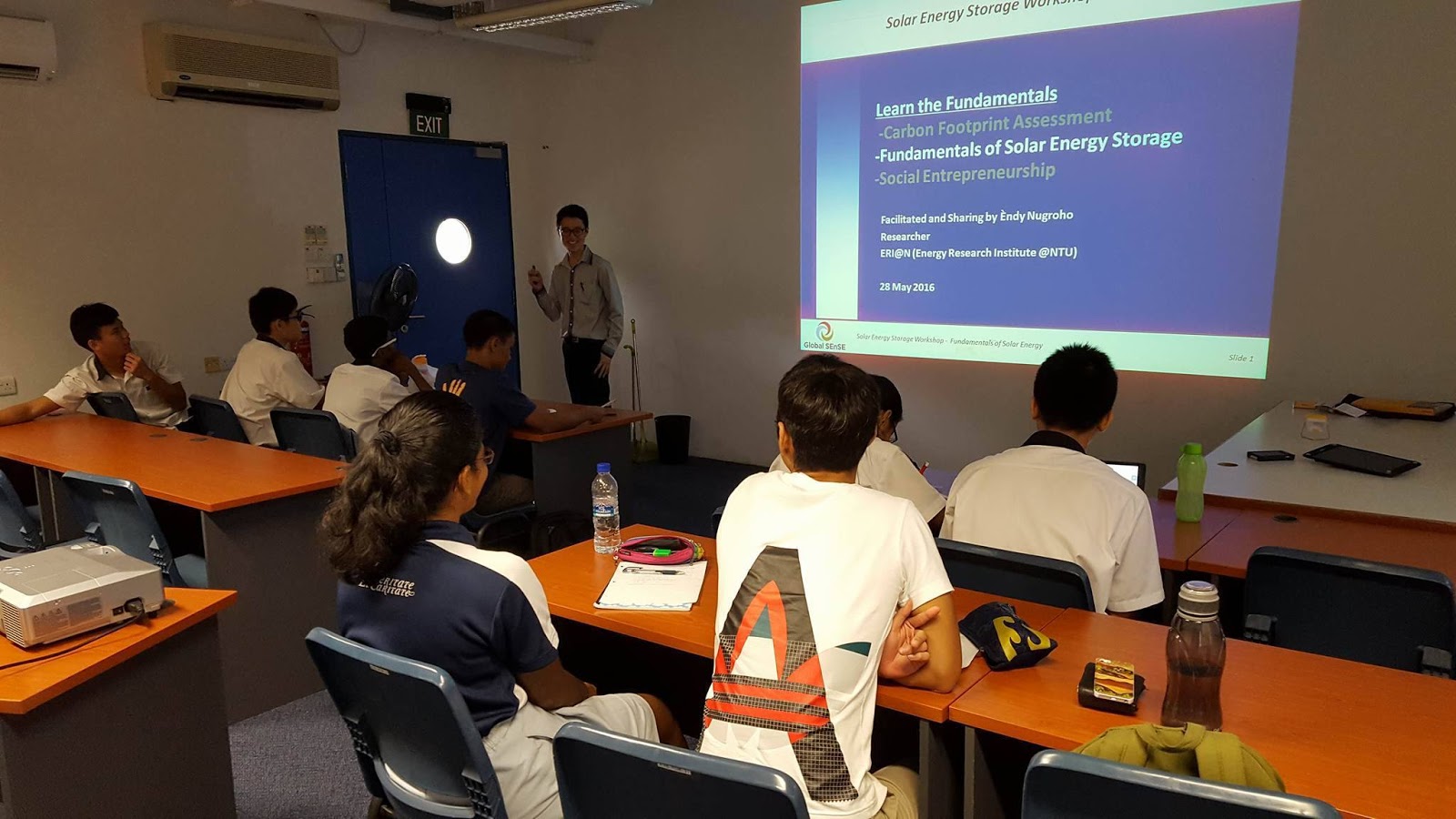


This year, the hackathon is run at the Singapore Science Center on 14 - 17 June. there were 37 registered participants and the each team was given a 5.4W panel that produces 4.5V output.

The challenge was to use this panel to store energy (without the use of batteries or chemicals) in a sustainable way, and later allow the energy to be used to power LED bulbs or charge a phone. The solution should be scalable in the rural communities, like those in Nepal which are off the grid.

The participants are encouraged to recycle old toys and appliances for the storage and spend as little as possible, and use item which they think can be acquired in Nepal. 

After some brainstorming, mentors are assigned to each team to work with them on a solution that they could hack together in the next few days.


Some of the ideas were pretty ambitious, and others rather novel. Many of the students did learn a lot from school, and want to apply their knowledge, and during the hackathon, they quickly realized that it is actually very challenging to create a prototype, which it is easy to work out solution on the paper.

For example, the most common way to get energy stored to light a bulb or charge a phone is to use a motor as a generator, and picking the right motor to light up a bulb is not easy. Even a 3W motor can come in various sizes and even engineering students don't have any idea when it comes to creating a device. It is really a big test on their creativity and adaptability to work towards the solution with what they have.


Initially, some of the participants though of similar solutions, but implementing and creating the solution is NEVER the same. even when 2 teams want to store water, one team actually created their own pump out of a piece of wood in a circular plastic container and a motor.


The hands on experience on creating the prototype and managing their limited time is also a great learning experience as most knowledge are taught on books, and translating it to a physical product is something all the participants have no experience in.


After a few days of assembling materials and building their prototype, they have to present their solution to the judges.


The participants created a lot of novel solutions, and there were many iterations of the creation as there were lots of trail and error to get to what they want.


Time management was also very important, and some groups had a rather hard time managing time, and resources. And eventually had to scale down their solution to a simpler one.


Many interesting devices were created by the younger student, and even a "valve" derived by examining how the heart works is being tested.


The prototypes need to be functioning and not "pretty" and even so, it was not an easy task. For some projects, it became a crafts project, and one need to be handy and innovative to use limited resources.


In the end, one of the younger teams created a good device which they can demo (and works) to pump water to a height with a pump powered by the solar panel. And later, use the running water to turn a turbine and light up a bulb.


We would like to thank our main sponsor -- Ricoh Singapore that sponsored the Theta S 360 camera as prizes for the winners.

I had great fun organizing the event and was inspired by the young minds in their creative solutions. This was their first hackathon experience and they put in a lot of effort to work on the prototypes. They are also invited to travel to Nepal where there are several on the ground partners like Nepal Communitiere to host them to scale their prototypes up into other solution to empower the rural communities and earthquake survivors.

-- Robin Low

Sunday, June 19, 2016

The unequal distribution of resources


Many societies have come to a point where people feel that the unequal distribution of resources is part of life. Some of my friends in Singapore buy into the prosperity gospel -- a religious belief among some Christians that financial blessing is the will of God for them, and that faith, positive speech, and donations will increase one's material wealth. Others join mega churches and believe that they should earn more in order to give more.

In the US, my Conservative Republican friends dislike paying taxes and make socialism a dirty word. They also believe that people are poor because they are lazy, and seek ways to reduce social spending.

Resources are materials found in the environment that humans use for food, fuel, clothing, and shelter. These include water, soil, minerals, vegetation, animals, air, and sunlight. People require resources to survive and thrive.

Due to the difference in the environment that results in different natural conditions, resources are distributed differently across the globe. Countries that do not have the resources they need can trade for them. Sometimes, conflicts happen when countries try to control resource rich territories.
Within the countries and society itself, there is also unequal distribution of resources. Today, the income gap is widening. Many people consume fewer resources they need for survival and well-being. As a result, there is much poverty in these countries. However, not everyone in these countries is poor, there are also a few people controlling all the resources, making them very rich.
This unequal distribution of resources, the legacy of imperialism, is the result of human rather than natural conditions. But this problem is not only found in third world countries, many countries do see a large income gap and the number of "working poor" in these countries is also on the rise. In fact, the world’s 62 richest people hold as much wealth as the bottom 3.5 billion in 2016.
We praise billionaires for their charitable donations and philanthropy. But where do they get their massive wealth from? Many of these billionaires are driven to make as much money as possibly at any cost. After making money, they hoard their wealth and give a small portion to charity while putting the rest in a tax free financial vehicle.

Corporations are also hoarding Trillions of dollars; some say they hold it for a "rainy day", while some corporations focus on "tax efficiency" which most of us call "tax avoidance". If they were to spend it, the economy would instantly grow, and we could see more jobs with better pay. Strangely, the stock market is also rewarding companies for hoarding money, namely software and healthcare companies which hoard the most cash.

Perhaps this is a result of our dysfunctional society, a society where people suffer from curable diseases simply because they cannot afford medical care -- because they are too poor. There is massive income inequality in the world and many that could not earn a sufficient living now require aid in order to get by.

In many societies, people with materialistic wealth are looked up on as idols. No matter where he gets his wealth from, corruption, unfair business practices which kills of other smaller competition, he gets more respect for having more.

Many aspire to accumulate wealth and will find all means to get there, and only when they are rich, they participate in philanthropy. This is the kind of mindset that creates the income inequality, where people around die from poverty and creates a need for the billionaire philanthropists to come to the rescue.

We need to address the distribution of resources at the root. We need to treat people in our society with empathy and consideration. It is definitely possible to do well while doing good. Through social innovation, marginalized communities can be freed from a life bound by servitude and dependency.
Poor people are not stupid. They have ideas and aspirations, but lack resources to even solve their most immediate problems. They do not need the help from the billionaire philanthropists; they do not need aid and donations. They need to be able to be included in deciding their future, and be connected to be resources and be empowered to solve their own problems.

What we need is just for people to rethink their consumption habits. Supporting chain stores who exploit their workers in the different levels of supply chains, just because they sell cheaper products may not the best way to save money. We need business owners who treat their workers with respect and encouragement. We do not need to worship billionaires because it will encourage people to accumulate their wealth at any cost.

Everyone plays a role to empower their communities and enable the ones who are marginalized to do more. Charities are temporary solutions and the main problems we need to address the unequal distribution of resource.

Billionaire philanthropists and large corporations do not hold the solution of the problems we face today, it is up to us to take actions and accountability to make things right.

-- Robin Low

Wednesday, June 1, 2016

Scapegoating


It is normal for people to push blame to others, especially when there are voiceless.

Scapegoating is the practice of singling out any party for unmerited negative treatment or blame as a scapegoat. Scapegoating may be conducted by individuals against individuals (e.g. "he did it, not me!"), individuals against groups (e.g., "I couldn't see anything because of all the tall people"), groups against individuals (e.g., "Jane was the reason our team didn't win"), and groups against groups.

For many years, donations have been the default model to help people living in poverty. Nothing much has changed to improve the lives of the recipients of aid, and they are often blamed for it. Many social enterprises give jobs to people from marginalized communities. Some of them pay only minimum wage, and others who hire the elderly or disabled may only hire them part time denying them benefits. There is also often no progression in the jobs, and when these people leave the job, they are often blamed for not sticking to the job. Without engagement many NGOs and governments think of solutions to help these communities. And the communities are told to be grateful and just accept what is given to them. The solution may not work as usually foreign experts are used and no consultation is done, and there is also very little buy in from the community. When the project fails, the communities are blamed for the failure.

-- Robin Low

Sunday, May 8, 2016

Solar Forward - Allow survivors access to sustainable energy #Nepal #Earthquake

Following the Nepal Earthquake in 2015, many communities were left without power. However, even after a year, the power has not returned to these communities. Many NGOs has called for donations of solar kits to give some of these communities light. I met up with various of these groups and they were interested in giving a few hundred solar kits to villages, however, as there were millions living in the dark, the question I often asked is, “How do you pick who receives these solar kits?”
Looking at the projects and speaking to people from the villages. The feedback I received was that, there is a real need for light and cell phone charging. Having a few more hours of productivity, having energy to power lights and charge cell phones is very important indeed. The fact is, many of these communities do have a need to charge their phones for communication. Their kids do go to school, and light is important for them to do homework. Some of the residents in the villages do have other work besides farming, and a few more hours of light could make them more productive.
I felt that access to sustainable energy is a basic human need. For a post disaster community, there will be NGOs to give food, water and shelter, but these communities also need sustainable energy. But when funding is limited, the question is who will receive these solar kits, and how do we make more people benefit eventually?

From the engagement with the various communities, I got to know that some of the farmers in the villages do have extra work on the side. These farmers are also tailors, cobblers and artisans. They work after the day ends, and a few more hours of light would mean extra income for them. This extra income would mean a big difference in terms of earnings, and they could now make more money and save up to rebuild their homes.

Solar Forward is a crowdsourced project that plans to raise funds to bring in 500 low cost solar kits, consisting of Solar Panels, LED bulbs and a charger which can store the energy and charge cell phones. The local team in Nepal will curate 500 people from the various villages damaged by the earthquake, and give them these solar kits. The criteria for the curation are how much more these communities would make if they were given a solar kit.
If the family would earn at least US$1 more per day, just by having 4 more hours of light, and they would save the extra $1 a day, in 60 days, they would have US$60, which could buy another kit for someone else in their village.

If this family would agree to save up and buy another kit to benefit someone else in the village that would have financial gains when they receive the kit, they would be a potential candidate to receive the solar kit. This is testing a pay it forward model, which transforms the victim of an earthquake from a passive receiver of aid, to an active participant in the recovery process, empowering them to support others in their villages.

Working with Nepal Innovation Lab, studies on success or failure of the project, and how the community reacts to the pay it forward model will be studied and the results shared.


There is also a concern for those who do need the solar kit, but cannot commit to saving an extra US$1 a day. Many families could however, save up US$0.30 – US$0.50 a day. These families would be part of the phase 2 of the Solar Forward project. Once the initial 500 solar panels arrive, the cost of shipping, customs clearance would be confirmed. And we can have the exact price of each of these panels delivered to Nepal.

The local Nepal team is also now looking at finding foundations and various institutions to be bank guarantors. As the communities are out of the banking system, it is very hard for them to get a US$50 loan for the solar kit. Having a bank guarantor would allow them to access the bank loan. And after building credit by paying off the loans, these communities could be integrated back into the banking system and have access to more loans.

The initial calculations show that they can pay a US$50 loan in as little as 7 months if they save US$0.30 a day. And the other benefit would be that after paying off the loan, the communities could also build up a credit history for them to have access to the banking system.
Lastly, for those who may not even save US$0.30 a day, they can also access microfinance, which will train them in running a business or other skills which will help them generate income, and the microfinance companies could them put them on a microfinance loan, allowing them access to solar energy.


This project is still ongoing, and the results will be made available once the project is completed. 


If you would like to contribute to Solar Forward, the fund raising page is here. 


-- Robin Low


Sunday, April 24, 2016

Relook at Social Entrepreneurship

I would call a social enterprise a company with a triple bottom line: social, environmental (or ecological) and financial. It needs to serve a social need, and it needs to be both environmentally and financially sustainable.


You see this diagram in many books talking about social entrepreneurship. The definition of a social enterprise today is very vague, and many even argue if there is a need to have such a definition.

It is already not easy to run a "social enterprise" but I do find many people interested in this field. Across the world, social enterprise is the buzzword to get the support from various governments. But when you do look into the various business models, there is so much grey areas where the organization operates.

----------------------------------------------------------------------------------------

In Singapore, the NTUC is considered a social enterprise. They run an insurance company, supermarkets and various other commercial enterprises. National Trade Union Congress in Singapore is a politically backed company after the Singapore Association of Trade Unions (SATU) collapsed in 1963 following the government's detention of its leaders during Operation Coldstore and its subsequent official deregistration on 13 November 1963, leaving the NTUC as the sole trade union centre.

As most of the leaders in NTUC are members from the PAP party, NTUC's operations is closely seen as PAP's operations and hence it is much supported by the government to run social enterprises which has lower cost services.

However, I do not really see NTUC Fairprice having lower cost of food. NTUC Foodfare seemed to charge a much higher price for food with some of the similar chain stores found in other foodcourts, And the one in AMK hub especially has similar foods that costs even more than Orchard Road.

With NTUC considered as a social enterprise in Singapore, Singapore can declare themselves to have one of the largest social enterprises in the world.

With such a broad definition of social enterprises, it is hard not to identify yourself or not identify yourself as a social enterprise in Singapore.

Ways you can call your business a social enterprise.

If you hire elderlies or disabled (due to wage subsidy from government), you can consider yourself a social enterprise as you employ the marginalized.

If you hire the marginalized such as ex-offenders, (due to wage subsidy from government), you can consider yourself a social enterprise.

If you use recycled or sustainable products, you can consider yourself a social enterprise.

If you carry out activities which benefit a certain group of NGOs, like doing some pro-bono work for a VWO, you can consider yourself a social enterprise.

If you donate part of your profits to charity, you can consider yourself a social enterprise.

If you sell sustainable fashion, you can consider yourself a social enterprise.

If you run (paid) courses for the marginalized, you can consider yourself a social enterprise.

If you build products that some marginalized people can use, you can consider yourself a social enterprise.

The list goes on...

So eventually, if you register with the Social Enterprise Association (Which seems rather dormant), you can consider yourself a social enterprise.

===============================================================

So why is this good (or bad)?

I feel that generally, when everything is a Social Enterprise, it can hardly demand differentiation. 

I would argue locksmiths, plumbers or electricians are social entrepreneurs as well as they do serve social need. What about Hybrid Taxi Drivers? Ooooh, they are sooo Green, and they sometimes transport the needy.

The Social Enterprises which creates a big social impact may now find it more difficult to differentiate themselves from the "greenwash" or "whiteswash" social enterprises, and people may not really care otherwise.


===============================================================

Are social enterprises even needed then?

I personally feel that commercial enterprises that primarily focus on profits or interested in the needs of the shareholders is simply wrong. The whole capitalism has warped our sense of reality that we praise businesses that are doing something good.

I really want to discourage students who are interested starting businesses today to start social enterprises if all they want to do is to sell things to the poor.

"Bottom of the Pyramid" 

I really hate this concept of looking at "the poor" as a market to sell things to. The poor does not need low cost pop corn, potato chips or soda... They do not need LCD TVs or other non essentials. 

I really cringe when some of the young entrepreneurs decide to raise funds to make products to target "the poor" after reading the book...

There are needs and wants. If you can find a solution to allow the poor access a need, like lower cost healthy food, sustainable energy, clean water, etc. And if you find a financial model and a distribution model which allows them to buy these needs, great! You are doing good while running a business.

This however may seem to be a fairytale. I'm trying to bring low cost solar kits to rural communities and for them to afford, you need a fantastic logistic model which is efficient and low cost, you need to cut out the middle man and connect to the end users directly, you need to have a low profit margin. All of which most people who you may seek finance from will definitely not fund you.

Most "Impact Investors" -- unfortunately -- are still looking for a profit margin. If they provide the risk capital, they want returns (20% ROI)? And this means your retail price has to be 20% more, an amount which the beneficiaries and target audience may not afford.

In my opinion, there is not really a good place for social enterprises as the corporations are already doing CSR, and the charities are trying to make income. With the confusing definition, people may not even tell the difference between companies and social enterprises.

If you want to create real social impact, stop trying to sell things to "the poor" and think of them as a "Market". With more needs available to them, they may not save enough money to acquire assets which they need to get out of poverty. 

If you are running a social enterprise, make sure you can create positive social change, real social impact, instead of just running a business, pretending to do good.

-- Robin Low

Sunday, April 10, 2016

Crab vs Turtles

Crab Mentality
This is an experiment you can do to learn more about crabs.

In many markets, crabs are sold in an open bucket, and there is no need for any covers as the crabs do not escape.
Whenever a crab tries to climb out of the bucket, other crabs will pull it down when it gets close to escaping.
“I can’t have it, neither can you”
Crab mentality can manifest in many forms, and in many communities, they feel powerless and they get joy when they see others fail, and fear of failing prevents these communities from moving forward. There may be many problems that these communities face, but they do not work together to solve the problems.
Also known as Crabs in a bucket, this is the kind of mindset that some communities have to prevent them to moving forward. It is far more common than you think. In Singapore, there is a term called

“Kiasu” which is prevalent in Singaporeans.


“Kiasu” or “Fear of losing” is seen by some people as a positive thing. It makes Singapore a very competitive society, always trying to be the best in things. This mindset permeates through many differ organizations in Singapore. The Singapore government call it a meritocracy society, where the top students in schools are on full government scholarships and groomed to be leaders. And these leaders are paid many times the average salaries of average Singaporeans, and often placed in top positions in the government or government linked companies.
This mindset has worked in building Singapore the way it is, but it also creates a lot of stress as everyone is very competitive. For some Singaporeans, success also means others should fail. This is the definition of crab mentality and it fragments a society and there is low public trust.

Turtle mentality


Where crab mentality is not desirable, turtle mentality is positive (and adorable)
Baby turtles help each other dig out from a pile. The ones in the bottom push the ones on top upwards until everyone comes out. The process takes about an hour and no one was left behind.
I’ve also known many friends who own terrapins as pets and these turtles will find ways to help their friends escape if the cover of their aquarium is not closed property and they can reach it. Through teamwork, these turtles climb on each other and push the one closest to the top and help him escape.
Many communities have very close relationships and support one another. In Japan after the Tsunami, the survivors self-organize their cleanup and shop owners on the street gather every day to decide on which shops to clean up, allowing them to more efficiently clean the debris and mud than each shop owner cleaning their own store.
In Haiti, I’ve worked with Haiti partners and seen people in the village pooling money to send the children in their village to high school in Port-au-Prince. The people in the village also come together to apply scholarships for all the eligible children and pool money to send them to universities.
Working together allows the villagers to accomplish tasks which may be difficult if a family were to do it alone. There are many examples of farmer cooperatives set up in rural villages to pool resources for bulk purchase and negotiate sales.

When working with communities, it is important to find ways to change their mindsets. It is not just having a solution that matters, but how the change can be sustainable. If the community has crab mentality, the people you help may be pulled down again by others in the community and it is important to address the mindsets as well.


-- Robin Low

Thursday, April 7, 2016

How do I deal with all the drama while striving for positive impact?

It is not easy doing good. Creative People who work on innovative solutions when faced with bureaucracy, rejection or simply lack of support can easily burn out and suffer from depression.

I have been working with marginalized and post disaster communities for more than 8 years now, and today, I see more young people working on social projects or starting social enterprises. This is very encouraging, however, I have also seen many others burn out from time to time. Doing good is not as easy as you may think, and I too at times feel down.

I have volunteered for various organizations and been to many major disasters in the past 15 years. The work is inspiring and addictive. When I volunteer at disaster areas, I feel that my work is very meaningful, and I do feel that many benefited from my presence. However, at times, when I see a problem and I am not empowered to solve it due to bureaucracy, I feel disappointed especially if the bureaucracy and inaction actually causes harm.

Bureaucracies of large organizations cause these organizations to be unable to handle changes on the field, and even when I complained, it was largely ignored. I co-founded Relief 2.0 in 2011 and we went to Japan after the Tsunami and carried out the process of “running the last mile of disaster relief” where we provide what is not provided on the field and do the tasks which are not performed.
When the organizations deliver donated clothes but no one use them, Relief 2.0 members engage the kids in the shelters to sort clothes which makes it easier for the survivors to find what they need. Relief 2.0 also engages volunteers to redistribute food among the shelters.

Post disaster, Relief 2.0 works on getting the communities to help one another to rebuild their economy. Relief Business to Business (Relief B2B) is the practice where we interview shopowners of the damaged stores asking 4 simple questions; “What happened during the disaster?”, “What did you lose?”, “How much do you need?”, and “What are you going to use the money for?” We will record this in a video to bring to the next town and gather business owners to come and give interest bearing loans instead of donations to help the affected business restart. This process of getting the communities to support one another has proved useful and we get students in the local universities to carry out what we started.
The motto that we work with is “Never Help; Engage, Enable, Empower and Connect.” We try to get the locals and the community to solve their problems and work with them to come out with sustainable solutions, or connect them to the help they needs to get it done.

Finding working solutions and solving problems is satisfying; however, there are also many frustrations that I face. From time to time, communications will stall and my contacts will simply stop communicating. When you work on projects, the locals in that country will miss the timeline or simple stop working without giving any feedback.

This problem is not just for developing countries, but my experience in Singapore is also very similar. Working with the recipients of the support may be frustrating as they sometimes do not turn up for free trainings, and simply not come to work when you hire them and no reasons are given. In some cases, they are just not professional, but sometimes, there are a lot of other pressing issues that the marginalized communities face which they either assume you know, or they are too ashamed to share.
I’ve once worked with a farmer which I funded to support him for farming, and when I found that all the vegetable seedlings died even when the weather was good, I got frustrated with him for avoiding me, but later found out that he contracted dengue fever and was sick for weeks and too ashamed to contact me for losing everything.

In some cases, the communities you want to create are not as enthusiastic as you. I want to create an entrepreneurship eco-system for kids in Singapore, and I’ve started Dreamity Entrepreneurship bootcamp. Many parents are interested, but studies always come first and everything else is secondary. The kid’s business will be halted for exams and homework, and in most cases, a long pause usually means that the business will be discontinued.

For many social projects, finding funding is very hard. The government may have schemes, but your project has to fit exactly into their scheme before they consider funding, and application takes a long time. Corporates and business may be interested to be sponsors, but many want to know how the project will benefit them.

I’ve worked on several projects where funding and free venue was agreed, and a month before the event, everything was cancelled without giving any valid reasons. Sometimes, volunteers will have all sorts of excuses for not showing up, or bring their drama to the projects.

In the field of social innovation, the financial gains usually is relatively low and the frustration is high as few people see the work as a low priority – and these people include the recipients of the support. Some  people over commit themselves. They give not only time and effort, they take on financial burdent to get things done. When things do not work out, these people burn out.


For me, I see this as a learning journey. I learn about different cultures, behaviors and people. I look at different solutions and share them between communities. I see myself more as a facilitator and a catalyst for change, and encourage the marginalized communities to want to change from within. I am not their savior, and without me, these marginalized communities still continue to exist. Although I may face a lot of rejections and failures, I put in my best effort but not take more responsibility that I can commit. I know that if I do have progress, many will benefit, and if I fail, I can still start over.

-- Robin Low